 en
en  it
it
news
News | Main news
Industrial Chillers: Essential Solutions for Thermal Control in Precision Manufacturing
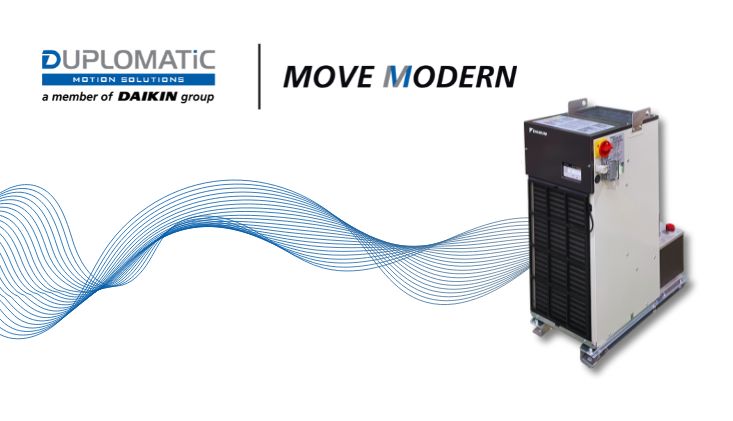
Machine tools generate a significant amount of heat during operation, due to high power usage, mechanical friction, and the high rotational speeds of spindles and cutting tools.
This heat buildup affects critical components such as electric motors, drives, transmission systems, spindles, tools, and even the workpiece itself.
The resulting thermal expansion of metal, if not properly controlled by a reliable thermal management system, can compromise machining accuracy.
To mitigate this, cooling oil and cutting fluids are circulated inside the machine to remove heat from components, tools, and workpieces.
The system responsible for this thermal control is the chiller. Its performance is measured by its ability to prevent thermal distortion by extracting heat from the fluid and maintaining a constant temperature.
Industrial Chillers: More Than Just Heat Exchangers
Unlike conventional water coolers or simple fans, industrial chillers perform precise temperature control that goes beyond mere heat exchange. They actively monitor and regulate the refrigerant temperature within a closed, isolated circuit.
The operating principle: a four-phase thermodynamic cycle.
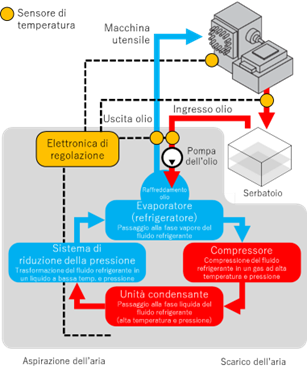
The operation of industrial chillers is based on a thermodynamic cycle consisting of four fundamental phases, as illustrated in Figure 1.
-
Compression: The refrigerant, initially contained within a closed circuit, is compressed by a compressor. This action significantly increases its temperature and pressure, transforming it into a high-temperature, high-pressure gas.
-
Condensation: The compressed gas is then directed to a condensing unit. Here, it releases heat to the external environment (or another cooling fluid) and cools down, changing its state into a high-temperature, high-pressure liquid.
-
Expansion: The high-temperature, high-pressure liquid reaches the expansion system, where it is injected and decompressed through an electronic expansion valve. This process causes a drastic drop in pressure and temperature, generating a low-temperature, low-pressure fluid. This low-temperature fluid is ready to absorb heat. The amount of refrigerant circulating in the system is precisely regulated by adjusting the valve opening in response to the cooling capacity demand.
-
Evaporation: The low-temperature, low-pressure fluid enters the evaporator (a heat exchanger). The energy required for evaporation (latent heat of vaporization) is supplied by the oil or coolant from the machine tool, which consequently cools down. During this heat exchange, the liquid refrigerant transforms into a low-temperature, low-pressure gas. This gas is then drawn back into the compressor, closing the cycle and ready to restart.
Key components of an industrial chiller:
The proper operation of an industrial chiller depends on the precise interaction of several key components.
-
Compressor: It is the heart of the system, responsible for increasing the pressure and temperature of the gaseous refrigerant.
-
Condenser Unit: Its task is to cool and condense the high-pressure gaseous refrigerant into a high-pressure liquid, dissipating heat.
-
Expansion System (Electronic Expansion Valve): It regulates the flow of refrigerant and drastically reduces its pressure and temperature before it enters the evaporator.
-
Evaporator (Heat Exchanger): This is where the actual heat exchange occurs, with the low-temperature refrigerant absorbing heat from the oil or cooling fluid, thus cooling it.
-
Refrigerant: It is the working fluid circulating within the closed system, absorbing and releasing heat during phase changes.
-
Regulation Electronics: A dedicated electronic system manages and controls each phase of the thermal conditioning cycle with high precision, optimizing the performance and efficiency of the chiller.
THE IMPORTANCE OF PRECISE TEMPERATURE CONTROL IN INDUSTRIAL CHILLERS
As mentioned, the primary function of an industrial chiller is to prevent thermal distortion of machine tools and workpieces. Maintaining a constant fluid temperature is crucial to ensure dimensional stability and the quality of the finished product. With the increasing precision required by modern machine tools, extremely accurate temperature control of the liquid is becoming more and more necessary. The long-term trend in the chiller industry is the continuous improvement of the precision in liquid temperature control.
The Daikin Hybrid Technology "OilCon": An Innovative Approach
Daikin Industries, a renowned global manufacturer of air conditioning systems and hydraulic components, acquired Duplomatic Motion Solutions in June 2022, a company with a strong tradition in the design and production of motion components and systems in the hydraulic field.
Within its hydraulic division, which now includes the Duplomatic group, Daikin develops and produces high-performance, energy-efficient chillers for machine tools called "OilCon."
This name is inspired by Daikin's long experience in the air conditioning industry, a field where the company stands out for its expertise in refrigeration and inverter technologies. In fact, Daikin is the only air conditioning system manufacturer that develops all critical components used in the refrigeration cycle in-house. Daikin's chemical division is also at the forefront of developing various types of refrigerants with a strong focus on eco-friendly technologies.
Advantages of Inverter Technology in Daikin Industrial Chillers
Daikin introduced inverter technology for the high energy-efficiency control of electric motors back in 1986. The mass production of inverters led to significant advancements in the development of low-cost, high-efficiency units equipped with sophisticated algorithms for controlling the IPM (Internal Permanent Magnet) motors found in every Daikin appliance.
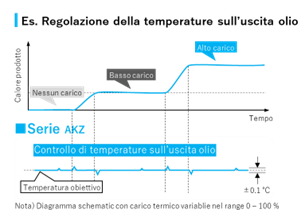
In OilCon chillers, the combination of these technologies results in highly accurate temperature control and significant energy savings. The inverter-controlled compressor allows for the modulation of cooling capacity based on the actual thermal load, avoiding unnecessary energy consumption. The high-efficiency IPM motor adjusts the compressor speed according to the required cooling capacity, ensuring extremely precise thermal control, typically with an accuracy of ± 0.1°C.
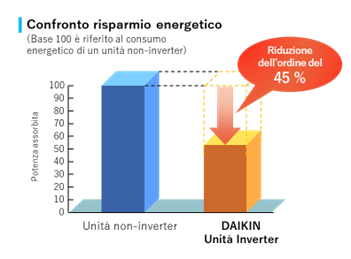
The thermal control performance remains almost constant regardless of variations in the thermal load, as shown in Figure 2. Compared to non-inverter models from other manufacturers, energy consumption can typically be reduced by about 45% (Figure 3).
The diverse applications of Daikin 'Oil-Con' industrial chillers
Based on the advanced technologies described, Daikin has developed several "OilCon" chiller configurations specifically designed for cooling refrigerants, lubricants, hydraulic oils, and cutting oils used in machine tools, as shown in Figure 4.
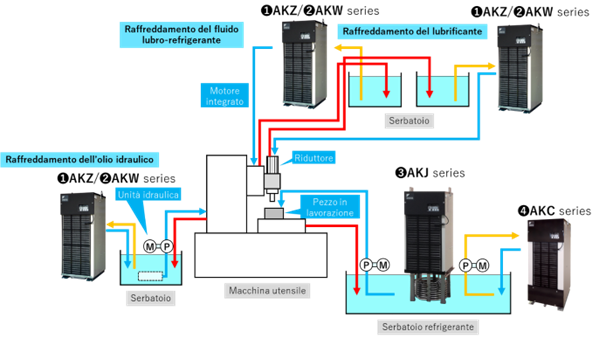
There are four types of chillers, distinguished by the type of liquid to be cooled (oil or water) and the installation method (recirculation or immersion). The temperature control method can also be selected based on the specific needs of the application. Three main control modes are available:
-
Control to maintain the temperature at a preset value.
-
Control to synchronize the temperature with the ambient temperature.
-
Control to synchronize the temperature with that of the machine tool.
The current models, such as the AKZ9 and AKZ10 recirculation series and the AKJ9 immersion tank series, achieve a standard temperature accuracy of ± 0.1 °C, while special specifications can support accuracies up to ± 0.01 °C, with accuracy remaining virtually independent of the thermal load.
The evolution of industrial chillers: towards Industry 4.0 and the IoT
With the increasing sophistication of machine tools, there is a parallel rise in the need for more precise control of the cooling liquid temperature. Recently, the integration of Internet of Things (IoT)-related functionalities into machine tools is becoming a standard. As a result, year by year, there is an increasing demand from users for IoT functionalities in chillers as well, and continuous developments are underway in this area. Although remote monitoring of chillers is already a commercial reality, the initial phase was limited to the simple connection of equipment. Currently, data is being collected to establish a precise correlation between the chiller fluid temperature and the machining accuracy of the machine tools. In the future, the application of artificial intelligence and machine learning to this data will allow for the quantification of the relationship between the fluid temperature and machining precision. This will pave the way for further advancements in control precision, moving from a feedback system that reacts to temperature changes by cooling the liquid, to a predictive control system where variations in liquid temperature are suppressed by anticipating upstream control of the required temperature based on the type of machining performed by the machine.
Sustainability and energy efficiency: Daikin's environmental vision for industrial chillers
Parallel to the increasing precision of machine tools, the number of chillers installed is also growing. Considering the growing attention of machine tool manufacturers towards more environmentally friendly systems, the demand for high-efficiency inverter chillers is steadily rising. Daikin's vision is strongly focused on sustainability and the contribution the company can make to society in achieving this goal through its products. Daikin is committed to achieving net-zero greenhouse gas emissions by 2050 at all of its locations and subsidiaries, with an intermediate goal of halving emissions by 2030. The company actively promotes the adoption of inverter technology in all its products and invests significantly in the development of the core technologies needed to improve the energy efficiency of its equipment. These technologies include fundamental research on high-efficiency electric motors, inverters, real-time motor control technologies, chemicals, high-efficiency eco-friendly refrigerants, as well as the recycling of equipment and the recovery of refrigerants from the market at the end of the product's life cycle.
Share
Latest News
-
News, Success stories
Success Story: LTE Lift Truck Equipment: greater efficiency in test benches with Daikin SUT technology
-

Eventi, News, Main news
Duplomatic supports “Japan–Italy: Friendship Continues” 2026
-

Eventi, News, Main news
Kaizen Race 2026: continuous improvement starts from everyday work