 en
en  it
it
news
News | Main news
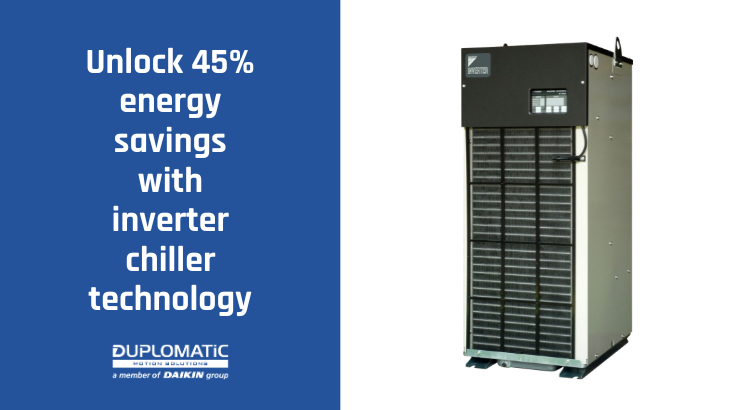
Industrial Chillers: unlock 45% energy savings with inverter chiller technology
Industrial chiller operation: a guide, regulations, and the advantages of inverter technology
What a chiller is and why it is essential for industry
The industrial sector, and particularly the machine tool sector, requires a continuous technical effort from mechanical and electronic designers to reduce both production times and the energy consumption of machinery, while maintaining the improvement of the finished product's quality as a fixed point. These are requests that Duplomatic MS can significantly help develop in collaboration with technical offices, proposing a series of products available on the market since the group's acquisition by Daikin in 2022. Let's try to provide some information on what a chiller is and how it works.
The chiller is commonly used to cool certain parts of machinery in multiple industrial applications, including injection molding machines, machine tools, laser machines, and more. In the industrial field, the chiller's function is to remove the heat generated by the movement of rotating parts or parts in relative motion, by means of a refrigerant fluid. As we well know, all industrial machinery has an efficiency of less than 100%. The difference in efficiency, or inefficiency, is all power that is transformed into heat. In other cases, it is necessary to remove the heat generated during the mechanical or transformation process, such as in the steel or food industries.
The refrigeration cycle and regulations on refrigerant gases (F-gas and GWP)
A chiller conveys heat from one fluid to another by means of the refrigerant gas, leveraging its ability to acquire and release heat through phase changes. Chillers use a specific gas, called a refrigerant fluid, which works on the basic principle of compression/expansion and the change of state of the refrigerant fluid from liquid to gas and back to liquid. The process that allows heat to be removed from a fluid, based on the compression and expansion cycle of the refrigerant, is called the refrigeration cycle.
Here is the first important thing to know: what type of refrigerant fluid (gas) can I use in compliance with current regulations? On the subject of refrigerant fluids, European regulations require particular attention to containing gas dispersions into the atmosphere. The goal is to gradually achieve climate neutrality (zero emissions) by 2050. It is therefore important to know the limitations defined at least at the European level. Regarding industrial chillers, the following limitations have been defined, summarized below:
- Chillers with capacities up to 12 kW, GWP must be <150 starting from January 1, 2027.
- Chillers with capacities over 12 kW, GWP must be <750 starting from January 1, 2027.
The GWP (Global Warming Potential) index is expressed as the ratio between the impact produced by 1 kg of gas and that produced by 1 kg of CO2 measured over a specific time interval. As for the European Community, among the most active worldwide for climate neutrality, we must consider both the restrictions imposed by the F-gas Regulation (Fluorinated gases) and those determined by the use of PFAS (PerFluorinated Alkylated Substances) in refrigeration systems. PFAS are substances defined as "eternal pollutants": once dispersed in the environment, they degrade over very long periods and can contaminate water sources and crops. Some of the F-gases currently used in chillers contain PFAS substances, and therefore a discussion is underway among European countries to arrive at a unanimous definition of the types of gases that can be used and from when.
The winning difference: on-off vs. inverter chillers
In the industrial sector, the compression chiller is used. To implement the refrigeration cycle, the refrigerant circulates through an evaporator, a compressor, a condenser, and an expansion element for the refrigerant itself. The core element of the chiller is the compressor, which has the function of bringing the refrigerant fluid to a high pressure value with a consequent rise in temperature, and then exploiting the rapid decompression and temperature drop that will be used to cool the process fluid.
There are chillers with on-off compressors and chillers with inverter-managed compressors. The difference is significant in terms of regulation precision; we go from a control of 1°C in the best on-off compressors to a thermoregulation of 0.1°C with inverter-managed compressors. It is evident that the more constant the temperature of the machine components is kept, the better the production precision will be, to the full advantage of quality. Furthermore, work speeds can be increased knowing that all the heat produced will be removed by the chiller.
A not insignificant factor, the inverter-driven chiller has reduced energy consumption compared to the on-off chiller. For the same cooling capacity, a reduction in power used of over 45% is estimated! In times of high energy costs, this is a factor not to be overlooked. The inverter-driven chiller perfectly meets all the performance requirements of an ideal chiller:
- Immediate response to thermal load variations.
- Ability to modulate its cooling capacity according to the thermal load.
- High precision in regulation and control of the process fluid temperature.
- Reliability throughout the entire operating range.
To reduce the possibility of atmospheric pollution due to gas dispersion, in Daikin chillers the compressor is hermetically sealed. Therefore, there are no leaks into the atmosphere.
How to choose the right chiller: key factors for correct sizing
What are the factors to consider when choosing the right chiller? Very often the chiller is oversized, not knowing in depth the factors that determine the necessary cooling capacity for proper operation. This will result in an installed power and consumption decidedly higher than what is actually necessary. To correctly size the chiller, it is necessary to rely on the professionalism of technicians who evaluate the type of application and the main characteristics of the machine. To select the most suitable chiller, it is necessary to know the outlet and return fluid temperatures, as well as the ambient temperature in the case of air cooling. Minimal temperature variations lead to significant variations in the electrical power absorbed by the chiller.
Duplomatic offers the market a team of highly qualified technicians, with decades of experience in the sector, able to recommend the best application in compliance with the policy of sustainability that distinguishes us.
Share
Latest News
-
News, Success stories
Success Story: LTE Lift Truck Equipment: greater efficiency in test benches with Daikin SUT technology
-

Eventi, News, Main news
Duplomatic supports “Japan–Italy: Friendship Continues” 2026
-

Eventi, News, Main news
Kaizen Race 2026: continuous improvement starts from everyday work